














To further standardize the application of robot-assisted single-port surgery in the field of gynecology and improve its operational safety and clinical efficacy, this expert consensus systematically summarizes the current technical status, indications, contraindications, and operational specifications. In recent years, with the advancement of endoscopic technology, laparoscopic surgery has revolutionized the thinking and practice of modern surgical procedures and has become the standard treatment for many gynecological diseases. As a continuation of traditional laparoscopic surgery, laparoendoscopic single-site surgery (LESS) has greatly transformed the landscape of gynecological surgery. The application of surgical robots simplifies complex procedures such as suturing in narrow spaces, reduces the risk of collision of single-port instruments, and enhances operational flexibility, surgical precision, visualization, and surgeon comfort. In 1999, the Cleveland Clinic published the first study on robotic gynecological surgery. However, only a small number of companies abroad have obtained marketing approval (such as the Da Vinci Surgical System and Hominis Surgical System), with several others reaching the human trial stage.
1 Current Status and Progress of Robot-Assisted Single-Port Gynecological Surgery
1.1 Multi-Arm Robotic Systems
(1) Da Vinci Robotic System
The Da Vinci system is the most commonly used robotic system at present. In 2005, the U.S. Food and Drug Administration (FDA) approved the Da Vinci Si system for gynecological surgery. Its high-definition video technology and finger-based clutch structure have addressed limitations such as instrument crowding and conflict, poor visual effects, and suboptimal ergonomic conditions. In addition, the dual console mode enables real-time teaching, collaborative surgery, and mentoring training, representing an important advancement in physician education. However, the VeSPA surgical instruments lack the EndoWrist mechanical wrist function, which restricts the distal range of motion and weakens instrument flexibility and surgical accuracy [1-3]. The Da Vinci Xi system, launched in 2014, features four robotic arms that can be docked with 7-degree-of-freedom EndoWrist instruments or 8 mm-diameter 3D high-definition cameras. It is equipped with functions such as overhead rotating arm suspension, laser guidance system, FIELD joints that maintain parallel movement of robotic arms to avoid interference and collision, and an integrated operating table motion system (robotic arms automatically match the movement of the operating table) [4-6]. It can be inserted into the abdomen via a single-port multi-channel approach and is more frequently used in single-port surgery.
(2) Other Robotic Systems
The Senhance system obtained FDA approval in 2017, while the MiroSurgery, ViaCath, and Versius robotic systems have not yet been approved.
1.2 Single-Arm Robotic Systems
(1) Da Vinci Single-Port (SP) System
In 2018, the Da Vinci SP system obtained FDA approval for urological surgery, and its parameters are shown in Table 1. It offers significant advantages in surgical technical performance in confined spaces and reduces intraoperative gas leakage. Rigid bimanual instruments provide better mobility, greater force, increased free access to the target area, reduced instrument collision, and avoidance of bouncing motion of surgical instruments, thereby enhancing surgical safety [7]. In addition, the multi-channel abdominal insertion port effectively shortens port placement and docking time and improves efficiency [8]. However, the tools of the aforementioned Da Vinci Si and Xi systems are incompatible with the Da Vinci SP platform [9].
(2) Other Foreign Single-Arm Robotic Systems
Currently, the Hominis Surgical System, Medrobotics Flex™, Inventoscopy E20, and FreeHand v1.2 have obtained FDA approval internationally, while the SPORT™, SPIDER, and MASTER robotic systems have not yet been approved.
(3) Domestic Single-Port Robotic Systems
At present, two domestic single-port robotic systems have been approved for marketing by the former National Medical Products Administration, with distinct principles and structures, as shown in Table 1.
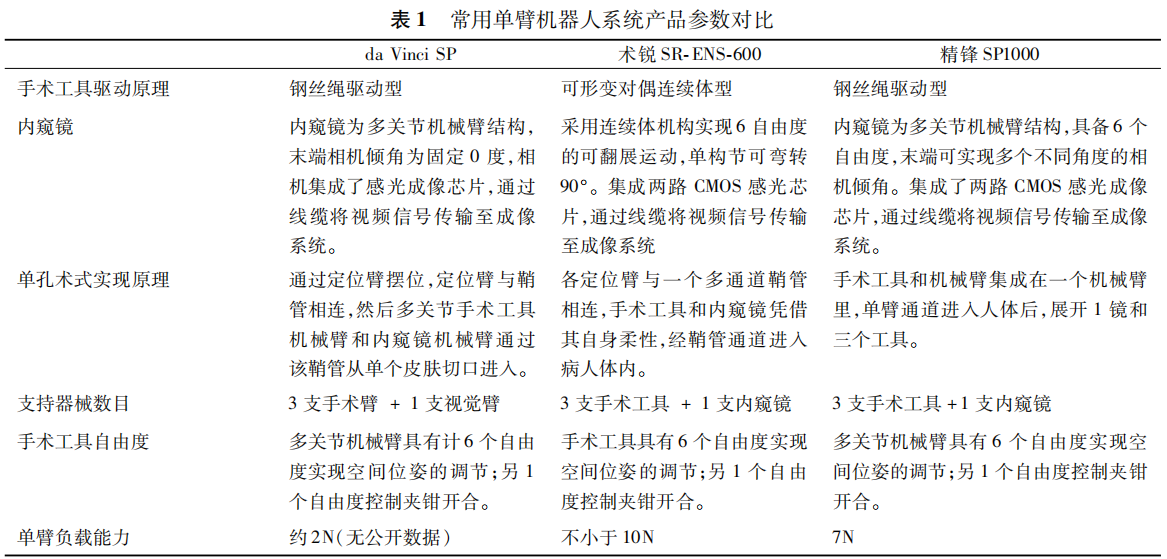
① The Shurui SR-ENS-600 Endoscopic Surgical System: The first case of ovarian cystectomy using this system was reported in 2022 [10]. From January to May 2023, Peking Union Medical College Hospital, in collaboration with five other hospitals including Beijing Jishuitan Hospital, Zhongda Hospital Affiliated to Southeast University, West China Second University Hospital of Sichuan University, The Second Affiliated Hospital of Wenzhou Medical University, and Zhongnan Hospital of Wuhan University, completed a 63-case single-arm clinical trial. The trial preliminarily verified the safety and efficacy of the system in surgeries for patients with ovarian cysts, uterine fibroids, cervical lesions, and endometrial cancer [11-12]. Chengdu Women's and Children's Central Hospital attempted to perform robot-assisted transvaginal natural orifice transluminal endoscopic surgery (R-vNOTES) using this system [13]. The system was approved for marketing in June 2023.
② The Jingfeng SP1000 System: Characterized by features similar to the Da Vinci SP system, it began a gynecological clinical trial in March 2022 at the Chinese PLA General Hospital, The Second Affiliated Hospital of Xi'an Jiaotong University, West China Second University Hospital of Sichuan University, and Zhongnan Hospital of Wuhan University. It was used to perform various common gynecological surgeries including ovarian cyst enucleation, uterine myomectomy, and total hysterectomy with bilateral salpingectomy. The trial preliminarily confirmed its safety and operability [14-15]. The system was approved for marketing in November 2023.
This consensus aims to assist experienced gynecological surgeons performing single-port laparoscopic surgery to implement robotic single-port surgery after adequate training and evaluation.
2 Indications and Contraindications of Robot-Assisted Laparoendoscopic Single-Site Gynecological Surgery
2.1 Indications
Currently, robot-assisted single-port gynecological surgery is mainly focused on robot-assisted transumbilical laparoendoscopic single-site surgery (R-TU-LESS), whose indications are consistent with those of single-port laparoscopic surgery, including: ① Accessory surgeries; ② Resection of uterine lesions; ③ Total hysterectomy; ④ Pelvic adhesiolysis; ⑤ Genital malformation surgery; ⑥ Pelvic floor reconstruction surgery, such as high-level uterosacral ligament suspension and sacrocolpopexy; ⑦ Early gynecological malignant tumor surgery, etc. However, due to current technical limitations, the indications should be more stringent [16-35].
The popularization of R-vNOTES still faces several limitations, with extremely limited reported cases. The expert group believes that surgeries in the above indications can be performed based on the surgeon's technical proficiency while adhering to relevant principles [36-40].
As a new technology, individualized selection should be emphasized, and new indications may emerge with technological progress.
2.2 Contraindications
The contraindications are consistent with those of general gynecological surgery, and also include difficult access routes such as umbilical malformation and vaginal atresia [41-42]. Relative contraindications include severe pelvic adhesions, a history of multiple abdominal surgeries, and a history of severe pelvic prior infection [43]. Vaginal stenosis and no sexual history are relative contraindications for R-vNOTES [41-42].
3 Preoperative Preparation
3.1 Imaging and Laboratory Evaluation
Mainly include pelvic ultrasound, and if necessary, detection of tumor markers such as CA125, and imaging examinations such as CT and MRI as reference for diagnosis.
3.2 Patient Preparation
Evaluate the patient's general status and correct all abnormalities. For non-Enhanced Recovery After Surgery (ERAS) patients, complete intestinal preparation, skin preparation, etc.; for ERAS patients, administer analgesics and oral nutrients on schedule.
3.3 Surgical Instrument Preparation
(1) Robotic Surgical Instruments
Robotic arms and matching instruments, including bipolar coagulation forceps, monopolar electroscissors, and atraumatic curved forceps, with other instruments used as appropriate.
(2) Laparoscopic Instruments
For assistants, including myoma grasping forceps, disposable specimen retrieval bags, and negative pressure aspirators.
4 Surgical Procedures
4.1 Patient Position
According to the surgical approach, adopt the same position as that for corresponding traditional multi-port laparoscopic surgery: head-down and buttock-up position, with lithotomy position or split-leg position selectable.
4.2 Selection of Operating Ports
Transumbilical single-port surgery is the most common approach. A longitudinal or annular incision penetrating the umbilicus with a length of 20–30 mm (35 mm for the Si system) can be made for the operating port. For R-vNOTES, the anterior or posterior fornix is selected based on the lesion and pelvic adhesions. Other approaches can be chosen according to the patient's condition.
4.3 Robot Setup and Technical Tips
After making the incision, insert a dedicated incision protector, insert a dedicated sheath into the dedicated port, adjust the depth of the sheath, and connect it to the incision protector to establish pneumoperitoneum. Adjust the patient's position. Generally, the surgical trolley is placed on the patient's right side. Connect and fix the sheath to the single-port robotic manipulator arm. After completing the robot setup, first insert the endoscope, place the instruments sequentially under direct vision, and the surgeon adjusts the joints or bending angles of the endoscope and each manipulator arm to form an operating triangle. For the Jingfeng robotic system, an auxiliary port can be made at the left lower abdomen (anti-McBurney point) or beside the single-port port [44]; the Da Vinci and Shurui robotic systems can directly use the auxiliary port on the dedicated port.
Operational Tips: ① Avoid an excessively small incision; ② When instruments block the surgical field, adjust the endoscope angle (e.g., adopt a cobra posture) to fully expose the surgical field without affecting the operation; ③ Place temporarily unused instruments at the upper right edge of the surgical field during teleoperation to ensure that the instruments are away from important pelvic organs and the surgical field, reducing collision.
5 Management of Surgical Complications
The main intraoperative complications of robot-assisted laparoscopic gynecological surgery include vascular injury, visceral injury, and nerve injury. The incidence of colorectal injury is 0.6%–2.8%, with the anterior rectal wall being the most frequently injured site [45]; the incidence of urinary system injury is approximately 0.3%–0.8%, mainly involving bladder and ureteral injuries [45-46]. Management should follow the basic principles for surgical complications; once an injury occurs, specialist consultation is required for management. To minimize the risk of intraoperative complications, patients must have sufficient blood preparation preoperatively and adequate intestinal preparation if necessary; if a lesion is suspected to compress or involve the urinary system, ureteral double-J stents or ureteral stents can be placed preoperatively. If the surgeon judges that the management risk is high, converting to open surgery is a more prudent option.
Umbilical incision complications are closely related to R-TU-LESS, with an incidence of 1.18%–10%, among which the incidence of umbilical hernia is 0.016%–2.4% [47]. Adequate fascial suture is an important method to prevent umbilical hernia. The peritoneum and fascia can be sutured separately or together using interrupted, continuous, or purse-string suture methods. After tying the suture, palpate to confirm no fascial defect before suturing the subcutaneous layer.
6 Summary and Prospect
In recent decades, the field of surgical robots has achieved substantial development, and R-LESS represents the next development trend of minimally invasive surgery. Most existing studies have confirmed that for most benign gynecological diseases, R-LESS has clinical efficacy no inferior to or superior to robot-assisted multi-port, traditional laparoscopic, and open surgery. For gynecological malignant tumors, more high-evidence studies are needed to expand its indications. Some benign gynecological diseases (such as endometriosis) and gynecological malignant tumor surgeries involve multidisciplinary collaboration. The 3D vision and unified robotic arm operation of robotic systems ensure consistent sensory experience for surgeons from different departments, facilitating multidisciplinary collaborative surgery, which is the direction of future surgical development. Robotic systems can also be combined with artificial intelligence (AI): AI-assisted preoperative surgical planning enables more accurate evaluation of surgical pathways and prediction of potential risks; intraoperative image recognition technology can identify anatomical structures in real time to help surgeons accurately locate lesions and reduce the risk of tissue injury; postoperative AI assists in data collection and analysis.
In robot-assisted surgery, surgeons still cannot directly perceive the actual force between surgical instruments and tissues/organs as in traditional surgery, which affects the safety of human-computer interaction. Therefore, breakthroughs in the improvement of force feedback systems, accuracy of surgical area tracking, and technical bottlenecks of ultrasonic energy instruments will open up more possibilities for single-port laparoscopic robotic surgery. The development of more advanced imaging systems and instruments such as vaginal-specific sheaths also provides the potential to expand the scope of application of robotic single-port surgery.
Using 5G signal transmission to realize long-distance surgical operation and training is a future trend. Currently, many hospitals have attempted various robotic laparoscopic single-port surgeries [48]. Further development of standardized training: progressive training from theoretical and video training, virtual surgical simulation, perfused organ surgery, experimental animal surgery to human surgery, and license issuance based on assessment will better ensure the safety and standardization of robotic single-port surgical operations.
References:
1 .Escobar PF, Haber GP, Kaouk J, et al. Single-port surgery: laboratory experience with the Da Vinci single-site platform [J]. JSLS, 2011,15 (2):136-141.
2 .Autorino R, Kaouk JH, Stolzenburg JU, et al. Current status and future directions of robotic single-site surgery: a systematic review [J]. Eur Urol, 2013, 63 (2):266-280.
3 .Douissard J, Hagen ME, Morel P. The da Vinci surgical system [J]. Bariatric Robotic Surgery,2019.
1. Panattoni A, Giannini A, Morganti R, et al. Perioperative outcomes of the first five cases of surgeries for endometrial endometrioid cancer using the new integrated motion for Da Vinci Xi® [J]. Int J Med Robot, 2021, 17 (4):e2254.
2. Ferguson JM, Pitt B, Kunz A, et al. Comparing the accuracy of the Da Vinci Xi and da Vinci Si for image guidance and automation [J]. Int J Med Robot, 2020, 16 (6):1-10.
3. Ngu JC, Tsang CB, Koh DC. The Da Vinci Xi: a review of its capabilities, versatility, and potential role in robotic colorectal surgery [J]. Robot Surg, 2017, 4:77-85.
4. Shin HJ, Yoo HK, Lee JH, et al. Robotic single-port surgery using the da Vinci SP® surgical system for benign gynecologic disease: a preliminary report [J]. Taiwan J Obstet Gynecol, 2020, 59 (2): 243-247.
5. Lee SR, Roh AM, Jeong K, et al. First report comparing the two types of single-incision robotic sacrocolpopexy: single site using the Da Vinci Xi or Si system and single port using the Da Vinci SP system [J]. Taiwan J Obstet Gynecol, 2021, 60 (1):60-65.
6. Iavazzo C, Minis EE, Gkegkes ID. Single-site port robotic-assisted hysterectomy: an update [J]. J Robot Surg, 2018,12 (2):201-213.
7. Ren C, Sun DW. Robot-assisted single-port laparoscopic bilateral ovarian cystectomy using the Shurui® system: a case report [J]. Intelligent Surgery,2022,3:9-13.
8. Chang R, Ping D, Yang S, et al. Effectiveness and safety of SR-ENS-600endoscopic surgical system in benign and malignant gynaecological diseases; a prospective, multicenter, clinical trial with 63 cases [J]. J Robot Surg, 2024, 18 (1):210.
9. Hu X, Ruan M, Zhu L, et al. This is the first in-human trial and prospective case series of a novel single-port robotic system for gynaecological surgery: an IDEAL stage 2a study [J]. Int J Med Robot, 2024, 20 (5):e2657.
10. Mei Y, Wang Y, Zhang Q, et al. Gasless transvaginal natural orifice transluminal endoscopic surgery for hysterectomy and salpingectomy on a robot platform with flexible devices in a porcine model [J]. Sci Rep, 2024, 14 (1):5366.
11. 张同乐,叶明侠,王铭洋,等。国产单孔机器人辅助腹腔镜下卵巢畸胎瘤剔除术临床试验:国内首例报道 [J]. 机器人外科学杂志 (中英文),2023,4 (3):258-263.
12. Gong P, Mao H, He T, et al. Initial outcomes and methodologies of a novel single-port robotic surgery in gynecology [J]. JSLS, 2024, 28 (4):e2024.00047.
13. Gungor M, Kahraman K, Ozbasli E, et al. Ovarian cystectomy for a dermoid cyst with the new single-port robotic system [J]. Minim Invasive Ther Allied Technol, 2015, 24:123-126.
14. Gargiulo AR, Feldmate C, Srouji SS. Robotic single-site excision of ovarian endometrioma [J]. Fertil Res Pract, 2015, 1:19.
15. Paek J, Lee JD, Kong TW, et al. Robotic single-site versus laparoendoscopic single-site surgery for adnexal tumours: a propensity score-matching analysis [J]. Int J Med Robot, 2016, 12:694-700.
16. Liu Z, Tian S, Yan Z, et al. Robotic single-site surgery for mature cyst teratoma cystectomy: an initial case series study in a single medical center in China [J]. Therapeut Clin Risk Manag, 2019, 15:179-185.
17. Kim S, Min KJ, Lee S, et al. Robotic single-site surgery versus laparoendoscopic single-site surgery in ovarian cystectomy: a retrospective analysis in single institution [J]. Gynecologic Robotic Surgery, 2020, 1:21-26.
18. Advincula AP, Song A, Burke W, et al. Preliminary experience with robotic-assisted laparoscopic myomectomy [J]. J Am AssocGynecol Laparosc, 2004, 11 (4):511-518.
19. Gunnala V, Setton R, Pereira N, et al. Robot-assisted myomectomy for large uterine myomas: a single center experience [J]. Minim Invasive Surg, 2016, 2016:4905292.
20. Sangha R, Strickler R, Dahlman M, et al. Myomectomy to conserve fertility: seven-year follow-up [J]. J Obstet Gynaecol Can, 2015, 37 (1):46-51.
21. Lee SR, Kim JH, Lee YJ, et al. Single-incision versus multiport robotic myomectomy: a propensity score matched analysis of surgical outcomes and surgical tips [J]. J Clin Med, 2021, 10 (17):3957.
22. Misal M, Magtibay PM, Yi J. Robotic LESS and reduced-port hysterectomy using the Da Vinci SP surgical system: a single-institution case series [J]. J Minim Invasive Gynecol, 2021, 28 (5):1095-1100.
23. Matanes E, Boulos S, Lauterbach R, et al. Robotic laparoendoscopic single-site compared with robotic multi-port sacrocolpopexy for apical compartment prolapse [J]. Am J Obstet Gynecol, 2020, 222 (4):58, e1-11.
24. Lee JH, Yoo HK, Park SY,et al. Robotic single-port myomectomy using the Da Vinci SP surgical system: a pilot study [J]. J Obstet Gynaecol Res, 2022, 48 (1):200-206.
25. Huang Y, Duan K, Koythong T, et al. Application of robotic single-site surgery with optional additional port for endometriosis: a single institution's experience [J]. J Robot Surg, 2022, 16 (1):127-135.
26. Kanno K, Andou M, Sawada M, et al. Segmental bowel resection for rectal endometriosis using the da Vinci SP [J]. J Minim Invasive Gynecol, 2025, 32 (1):14.
27. Corrado G, Meru L, Bogliolo S, et al. Robotic single site staging in endometrial cancer: a multi-institution study [J]. Eur J Surg Oncol, 2016, 42:1506-1511.
28. Kwak YH, Lee H, Seon K, et al. Da Vinci SP single-port robotic surgery in gynecologic tumors: single surgeon’s initial experience with 100 Cases [J]. Yonsei Medical Journal, 2022, 63 (2):179.
29. Kang H, Chung H, Lee S, et al. Comparison of long-term outcomes in early-stage endometrial cancer: robotic single-site vs. multiport laparoscopic surgery [J]. J Pers Med, 2024, 14 (6):601.
30. Gao J, Dang J, Chu J, et al. A comparative analysis of robotic single-site surgery and laparoendoscopic single-site surgery as therapeutic options for stage IBI cervical squamous carcinoma [J]. Cancer Manag Res, 2021, 13:3485-3492.
31. Jang TK, Chung H, Kwon SH, et al. Robotic single-site versus multiport radical hysterectomy in early stage cervical cancer: An analysis of 62 cases from a single institution [J]. Int J Med Robot, 2021, 17 (4):e2255.
32. Yoo JG, Kim WJ, Lee KH. Single-site robot-assisted laparoscopic staging surgery for presumed clinically early-stage ovarian cancer [J]. J Minim Invasive Gynecol, 2018, 25 (3):380-381.
33. Lee CL, Wu KY, Su H, et al. Robot-assisted natural orifice transluminal endoscopic surgery for hysterectomy [J]. Taiwan J Obstet Gynecol, 2015, 54 (6):761-765.
34. Yang YS. Robotic natural orifice transluminal endoscopic surgery (NOTES) hysterectomy as a scarless and gasless surgery [J]. Surg Endosc, 2020, 34 (1):492-500.
35. Koythong T, Thigpen B, Sunkara S, et al. Surgical outcomes of hysterectomy via robot-assisted versus traditional transvaginal natural orifice transluminal endoscopic surgery [J]. J Minim Invasive Gynecol, 2021, 28 (12):2028-2035.
36. 王景涛,黄桔园,邓鹏潮,等。第四代达芬奇机器人 Xi 系统辅助经阴道自然腔道内镜手术在妇科中的应用效果 [J]. 武汉大学学报 (医学版),2024,45 (2):47-151,179.
37. 刘娟,肖媛月,王倩青,等。盆腔器官脱垂手术新入路:机器人辅助经阴道腹腔镜阴道骶骨固定术 [J/OL]. 中华腔镜外科杂志 (电子版),2021,14 (3):168-171.
38. Nulens K, Kempeenaers R, Baekelandt J. Surgery in virgin patients: a Natural Orifice Transluminal Endoscopic Hysterectomy via vaginal first feasibility study [J]. J Obstet Gynaecol,2022,42 (1):116-121.
39. 孙大为。经阴道腹腔镜手术的探索与实践 [M]. 北京:清华大学出版社,2019:23-26.
40. Park JY, Kim TJ, Kang HJ, et al. Laparoendoscopic single site (LESS) surgery in benign gynecology: perioperative and late complications of 515 cases [J]. Eur J Obstet Gynecol Reprod Biol,2013,167 (2):215-218.
41. 公丕军,毛会,白莉,等。可弯曲单孔机器人临床应用研究及展望 [J/OL]. 中华腔镜外科杂志 (电子版),2023,16 (5):315-320.
42. Watroski R, Kostov S, Alkatout I. Complications in laparoscopic and robotic-assisted surgery: definitions, classifications, incidence and risk factors-an up-to-date review [J]. Widzchir Inne Tech Maloinwazyjne,2021,16 (3):501-525.
43. Glaser LM, Milad MP. Bowel and bladder injury repair and follow-up after gynecologic surgery [J]. Obstet Gynecol,2019,133 (2):313-322.
44. 中国医师协会微无创医学单孔与阴道腔镜学组,郑莹,熊光武,等。经脐单孔腹腔镜手术脐部切口管理专家共识 (2022 年版)[J]. 实用妇产科杂志,2022,38 (3):192-197.
45. 孙昊,党建红,李月明,等.5G 远程机器人辅助单孔腹腔镜妇科手术 1 例应用实践 [J]. 海军医学杂志,2025,46 (3):268-272.
Source
Chinese Journal of Laparoscopic Surgery (Electronic Edition), August 2025, Vol.18, No.4
Editor-in-Charge:Lily