














Menopause-related insomnia is a common symptom among perimenopausal and menopausal women. It is frequently encountered in clinical practice but easily overlooked, and this symptom can impair the health status of women during the perimenopausal and menopausal stages as well as in old age. Previously, there was a lack of dedicated consensus and guidelines for the clinical management of menopause-related insomnia in China. To standardize its management and improve the quality of sleep health management during the perimenopausal and menopausal periods, experts have been organized to formulate this consensus. The consensus covers core contents such as the establishment of a multidisciplinary expert team, medication management, and non-pharmacological management, aiming to provide guidance for clinical practice.
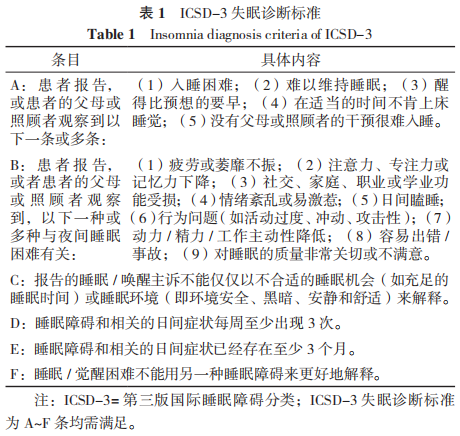
Insomnia is a common manifestation of poor sleep quality. If this symptom persists without relief, it will progress to insomnia disorder. Insomnia disorder is defined as the presence of persistent sleep disturbances despite having adequate sleep opportunities and a suitable sleep environment, accompanied by daytime functional impairment attributable to the sleep disturbances. The above symptoms must occur more than 3 times a week and persist for more than 3 months to meet the diagnostic criteria.
Menopause-related insomnia specifically refers to insomnia associated with menopause that cannot be attributed to other causes, and it is one of the common symptoms during the perimenopausal and menopausal stages. Without timely intervention, it is likely to progress to chronic insomnia, leading to more health problems and more severe functional impairment, and causing significant distress to women's lives during the perimenopausal, menopausal and elderly periods. Therefore, the management of menopause-related insomnia is an important component of health management during the perimenopausal and menopausal stages.
Epidemiology of Menopause-related Insomnia
Insomnia is the most prevalent sleep disorder, with an incidence rate of 10%–15% in adults. The incidence of sleep disorders in women over 40 years old is approximately 4 times that in younger women, and the incidence of insomnia among perimenopausal and menopausal women increases significantly, ranging from 13.2% to 65.1%. Results of polysomnography (PSG) indicate that such patients have shortened total sleep time, abnormal rapid eye movement (REM) sleep, prolonged sleep latency, and reduced sleep efficiency, which are specifically manifested as difficulty falling asleep, frequent nocturnal awakenings, prolonged awakening duration, and sleep maintenance disorders.
Pathogenesis of Menopause-related Insomnia
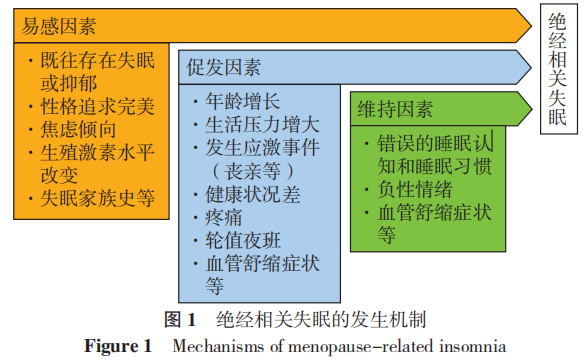
Sleep is a complex physiological process. The occurrence of insomnia involves multiple levels including individual behavior, social environment, organs, cells, and molecules, resulting from the combined effects of various factors. The development of menopause-related insomnia is based on predisposing factors, triggered by precipitating factors, and sustained by perpetuating factors (see Figure 1). Common predisposing factors include a history of previous insomnia or depression, perfectionist personality traits, anxiety tendency, changes in hormone levels, and a family history of insomnia. Precipitating factors include aging, increased work and life pressure, occurrence of stressful events (such as bereavement), poor health status, pain, shift work, and vasomotor symptoms. Perpetuating factors include incorrect sleep cognition and sleep hygiene habits, negative emotions, and vasomotor symptoms.
Impacts of Menopause-related Insomnia on Women
Menopause-related insomnia is closely associated with the female endocrine system, and there is an independent correlation between menopausal status and insomnia. Estrogen and progesterone can regulate and stabilize the circadian rhythm system. The decline in estrogen levels before and after menopause reduces the sensitivity of the hypothalamus to estrogen, which in turn leads to circadian rhythm disorders and induces insomnia. Among them, the decrease in estradiol (E2) levels is significantly correlated with difficulty falling asleep and frequent nocturnal awakenings, while the increase in follicle-stimulating hormone (FSH) levels is closely related to frequent nocturnal awakenings. In addition, vasomotor symptoms (such as hot flashes and sweating) and neuropsychiatric symptoms (such as anxiety and depression) caused by changes in reproductive hormone levels can also induce insomnia, and the severity of these symptoms is positively correlated with the risk of insomnia.
Menopause-related insomnia disrupts the normal sleep rhythm and exerts dual severe impacts on women's physical and mental health. Short-term insomnia can lead to inattention and memory loss. Long-term insomnia not only increases the risk of obesity, hypertension, type 2 diabetes, malignant tumors, coronary heart disease, stroke, and cognitive dysfunction, but also causes autonomic nervous system dysfunction, endocrine disorders, decreased bone mineral density, and increased risk of osteoporosis and fractures. Meanwhile, it may induce or exacerbate mental illnesses such as depression, anxiety disorder, and schizophrenia.
Clinical Screening and Diagnosis of Menopause-related Insomnia
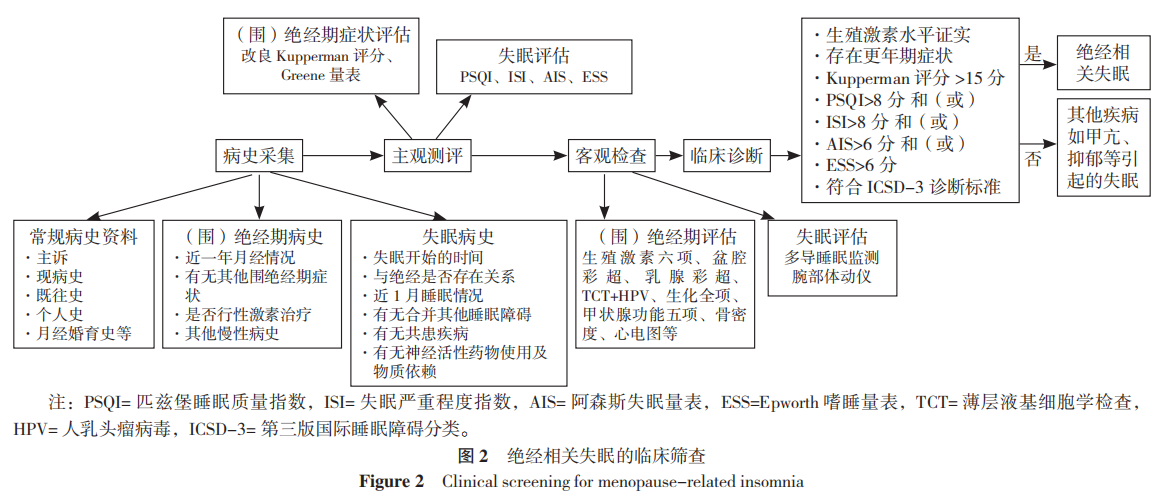
Clinical screening for menopause-related insomnia includes medical history collection, subjective assessment, and objective examination (see Figure 2). Among these, medical history collection is a key link, and detailed case data are important support for physicians to make an accurate diagnosis.
01 Medical History Collection
During medical history collection, attention should be paid to communication attitude and skills. The patient's educational level and comprehension ability should be fully considered to guide the patient to objectively state the condition. In addition to routine medical history inquiry, focus should be placed on perimenopausal and menopausal related symptoms and sleep-related conditions.
Key Points for Collecting Perimenopausal and Menopausal Medical History:
Menstrual status in the past year and whether accompanied by other perimenopausal and menopausal symptoms;
History of sex hormone therapy;
History of other chronic diseases.
Key Points for Collecting Insomnia Medical History:
Daily schedule, sleep status, specific manifestations of insomnia, and impact on daytime function in the past month;
Onset time of insomnia and its correlation with perimenopausal and menopausal symptoms and changes in menstrual bleeding patterns;
Whether complicated with other sleep disorders (such as obstructive sleep apnea, restless legs syndrome, etc.);
Whether suffering from comorbid diseases such as anxiety disorder and depression;
History of neuroactive drug use and substance dependence.
02 Subjective Assessment
Clinical screening is conducted using patient self-rating scales. Commonly used scales for assessing perimenopausal and menopausal symptoms include the Modified Kupperman Index and the Greene Climacteric Scale. Commonly used sleep assessment scales include the Pittsburgh Sleep Quality Index (PSQI), Insomnia Severity Index (ISI), Athens Insomnia Scale (AIS), and Epworth Sleepiness Scale (ESS). Clinically, a combination of "1+1" (1 perimenopausal and menopausal symptom scale + 1 sleep scale) or "1+2" (1 perimenopausal and menopausal symptom scale + 2 sleep scales) can be adopted for assessment according to actual conditions.
03 Objective Examination
Sleep Assessment
Polysomnogram (PSG): It can real-time monitor indicators such as electrocardiogram, electroencephalogram, muscle activity, eye movement, and ventilation function of patients during wearing. It can accurately describe the sleep structure and is the "gold standard" for assessing sleep disorders (especially obstructive sleep apnea). It can not only serve as an auxiliary diagnostic and differential diagnostic tool for insomnia but also evaluate the effect of cognitive behavioral therapy for insomnia.
Wrist actigraphy: Compared with PSG, it is smaller and more portable. It can assess sleep status and duration in a home environment and is an effective means to estimate total sleep time and awakenings during sleep. However, it lacks specificity and is not recommended as an alternative to PSG, only applicable in scenarios where PSG cannot be implemented or for large-scale population studies.
Comprehensive Perimenopausal and Menopausal Assessment
It includes six items of reproductive hormones, pelvic color Doppler ultrasound, breast color Doppler ultrasound, thinprep cytology test (TCT) + human papillomavirus (HPV) test, comprehensive biochemical examination, five items of thyroid function, bone mineral density measurement, and electrocardiogram, etc.
04 Diagnosis of Menopause-related Insomnia
Combined with the results of medical history collection, scale assessment, and laboratory examinations, the diagnosis of menopause-related insomnia can be made with reference to the third edition of the International Classification of Sleep Disorders (ICSD-3) issued by the American Academy of Sleep Medicine in 2014 (see Table 1).
Management of Menopause-related Insomnia
01 Establishment of a Multidisciplinary Expert Team
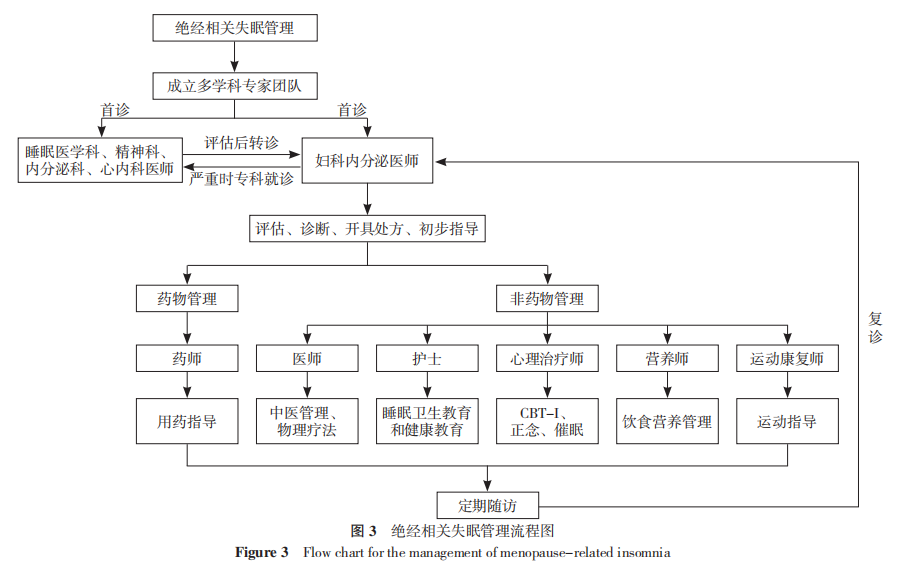
Patients with menopause-related insomnia often fail to realize the association between menopause and insomnia, and they visit multiple departments in the hospital, which increases time, manpower, and economic costs. A multidisciplinary expert team should be established, including physicians from gynecology, sleep medicine, psychiatry, endocrinology, and cardiology departments, as well as nurses, pharmacists, psychotherapists, exercise rehabilitation specialists, and dietitians. For patients with suspected menopause-related insomnia, a systematic assessment should be carried out at the first visit. After excluding insomnia caused by psychological factors, thyroid diseases, etc., the patient should be referred to the gynecological endocrinology clinic through the multidisciplinary referral system. Gynecologists will further evaluate and diagnose the condition, formulate individualized treatment plans, and maximize the feasibility of the plan, treatment effectiveness, and patient compliance (see Figure 3 for the management process of menopause-related insomnia).
02 Comprehensive Management
Medication Management
Pharmacological treatment has a good short-term effect on insomnia, but the core methods to correct insomnia are behavioral adjustment and psychological regulation, and long-term reliance on drugs should be avoided. The core goals of medication management are to enable patients to understand the effects, usage methods, and routes of the drugs they take, take the drugs on time and in the correct dosage as prescribed by the doctor, avoid incorrect administration or missed doses, and monitor relevant laboratory indicators regularly; teach patients to observe common adverse drug reactions by themselves and take the initiative to assume the responsibility of self-health management; return for follow-up visits on time, dynamically adjust the dosage according to the medication effect, achieve the best therapeutic effect with the minimum effective dose, and reduce drug-related adverse reactions.
Medication management for patients with menopause-related insomnia mainly involves menopause-related medication, targeted medication for insomnia, and medication management for other comorbid diseases. It is necessary to establish an individualized medication list and personal medication use file, which records in detail the start and stop time of drugs, occurrence of adverse reactions, dosage adjustment nodes, and individual responses.
For patients receiving hormone replacement therapy (HRT), the indications, contraindications, and precautions should be evaluated before medication. Patients should be fully informed of the advantages and disadvantages of hormone therapy, and the importance of taking medicine on time and returning for regular follow-up visits should be emphasized. After full communication and evaluation, for patients suitable for medication, according to their age, years since menopause, whether the uterus has been removed, expectations for drug-induced bleeding, etc., options such as estrogen alone, progesterone alone, sequential estrogen-progesterone therapy, combined estrogen-progesterone therapy, or tibolone should be selected (refer to the 2023 Chinese Guidelines for Menopause Management and Menopausal Hormone Therapy for details).
Various types of hormones can improve chronic insomnia in perimenopausal and menopausal women, but the type and usage of hormones will affect the therapeutic effect. For example, 17β-estradiol and conjugated equine estrogens (CEE) among estrogens can improve sleep quality, while estradiol valerate has no obvious effect, and transdermal estrogen has a better therapeutic effect than oral preparations; micronized progesterone can improve self-reported sleep quality and all aspects of the sleep cycle in postmenopausal women because its metabolite is a positive allosteric modulator of the γ-aminobutyric acid type A (GABA-A) receptor, which can produce sleep structure changes similar to benzodiazepines; transdermal 17β-estradiol combined with micronized progesterone treatment for 6 months can effectively improve the sleep quality of patients with menopause-related insomnia; tibolone is a synthetic steroid with estrogenic, progestogenic, and androgenic effects. It improves sleep quality by stimulating the production and release of β-endorphins, and due to its progestogenic effect, its sleep-improving effect is better than that of estrogen alone.
If insomnia is still not significantly improved after sex hormone therapy, hypnotic drugs can be appropriately added for short-term use. At present, commonly used hypnotic drugs in clinical practice mainly include benzodiazepine receptor agonists, melatonin receptor agonists, and antidepressants with hypnotic effects.
Benzodiazepine receptor agonists are divided into benzodiazepines and non-benzodiazepines according to their structure.① Benzodiazepines are classified into short-acting, intermediate-acting, and long-acting according to their half-life. Short-acting preparations are usually not used for insomnia treatment; intermediate-acting preparations are mainly suitable for patients with light sleep, easy awakening, and the need to keep a clear mind in the morning, and commonly used drugs include estazolam (1–2 mg per night), alprazolam (0.4–0.8 mg per night), lorazepam (0.5–1.0 mg per night), etc.; long-acting preparations have a slow onset of action and a long half-life, mainly used for patients with early awakening, and commonly used drugs include diazepam (5–10 mg per night). Such drugs can increase total sleep time and reduce nocturnal awakenings, but common adverse reactions such as drowsiness, dizziness, fatigue, amnesia, and falls may occur. Long-term continuous use may lead to dependence and addiction, and sudden withdrawal is prone to withdrawal symptoms, so strict control is required during use.② Non-benzodiazepines (such as zopiclone, zolpidem, etc.) have a rapid onset of action and a short half-life, and are mainly suitable for patients with difficulty falling asleep or those who cannot tolerate residual effects the next morning. This type of drug has better safety, weaker residual effects the next morning, generally does not cause daytime sleepiness, and has a lower risk of drug dependence than traditional benzodiazepines. Common adverse reactions include abnormal taste, dry mouth, dizziness, etc. Commonly used drugs and dosages are zopiclone (3.75–7.5 mg per night), eszopiclone (1–3 mg per night), zolpidem (5–10 mg per night), zaleplon (5–10 mg per night). They should be taken before going to bed. Sufficient sleep time should be guaranteed after taking the medicine. Driving, operating machinery, and engaging in dangerous operations should be avoided during medication, and drinking alcohol and alcoholic beverages is prohibited.
The consensus on the use of melatonin and melatonin receptor agonists (such as ramelteon and agomelatine) for insomnia treatment is not yet perfect. They are rarely used in the treatment of menopause-related insomnia, and their mechanism of action and efficacy still need further verification.
Antidepressants such as trazodone and mirtazapine can improve the symptoms of menopause-related insomnia to a certain extent. If the patient's condition is severe or recurrent, the patient can be referred to the department of psychiatry or sleep medicine through the multidisciplinary team referral system, and the patient's recent diagnosis and treatment status should be informed to the specialist to facilitate rapid grasp of the condition and targeted treatment. For patients with other comorbid chronic diseases, the original treatment plan should be continued, and the drug should not be stopped without permission. Regular follow-up visits to relevant specialist departments are required.
Non-pharmacological Management
Sleep Hygiene Education and Health Education
Take advantage of the multidisciplinary team to comprehensively assess the patient's physical and mental status, carry out popular science education on disease knowledge, help patients fully understand perimenopausal, menopausal and insomnia-related knowledge, eliminate worries and fears, adjust their psychological state, reduce depression and anxiety, and achieve physical and mental relaxation. Guide patients to create a good sleep environment: keep the indoor temperature at 22–26℃ and humidity at about 40%, turn off the lights before going to bed, avoid using mobile phones, and choose suitable bedding; advocate smoking cessation and alcohol restriction, avoid severe emotional fluctuations 1–2 hours before going to bed, do not drink coffee, strong tea and other beverages, and avoid falling asleep when overfull or on an empty stomach. Sleep hygiene education is the basis of non-pharmacological management and should run through the entire treatment process.
Psychological Therapy
Psychological therapy is implemented by professionally trained medical staff or psychotherapists. Common methods include cognitive behavioral therapy for insomnia (CBT-I), mindfulness therapy, hypnotherapy, traditional Chinese medicine (TCM) psychotherapy, etc. Among them, CBT-I is recommended as the first-line therapy for menopause-related insomnia in multiple guidelines.
CBT-I is a multimodal combined therapy, including sleep hygiene education, behavioral therapy (sleep restriction, stimulus control), relaxation training (progressive muscle relaxation), and cognitive therapy (cognitive restructuring, paradoxical intention). The specific implementation can refer to the Chinese Guidelines for the Diagnosis and Treatment of Adult Insomnia (2017 Edition). This therapy usually requires 6–8 sessions, 30–50 minutes each time, in the form of one-on-one counseling, group counseling, and web-based self-help. The effect can be observed in the short term, and the long-term efficacy is lasting.
Mindfulness therapy is a simple and feasible physical and mental intervention method, aiming to train patients to focus their attention on the present moment, let go of resistance to unpleasant experiences, accept their own feelings without judgment, and take conscious actions, thereby expanding the coping methods for stressful events. Core mindfulness techniques include mindful breathing, mindful walking, mindful visualization, mindful observation of emotions, body scan, mindful yoga, raisin exercise, etc. The treatment cycle is generally 8–10 weeks, once a week, 120 minutes each time.
Hypnotherapy is a special state of consciousness characterized by concentrated attention and reduced peripheral awareness, with the core feature of enhanced responsiveness to suggestions. It is mainly aimed at menopause-related insomnia and hot flash symptoms, and the goal is to teach subjects to reduce related symptoms through self-hypnosis. A complete hypnotherapy procedure includes five links: explaining and establishing a therapeutic relationship, hypnosis susceptibility test, hypnotic induction, implementing hypnotherapy, and hypnotic awakening, which is divided into two forms: therapist-guided hypnosis and self-hypnosis. Self-hypnosis can correct patients' incorrect sleep cognition, alleviate hot flashes and night sweats, improve sleep quality, and prolong sleep time, with high patient satisfaction and acceptance, making it a promising treatment method for insomnia.
TCM psychotherapy TIP technique (low-resistance thought induction psychotherapy) is a characteristic technique integrating modern hypnotherapy, psychoanalytic therapy, cognitive behavioral therapy, and traditional TCM psychotherapy. It has the advantages of lasting curative effect and low recurrence rate in the treatment of chronic insomnia.
Appropriate Exercise
Exercise can not only improve insomnia but also relieve other perimenopausal and menopausal symptoms, reduce the risk of osteoporosis, obesity and other diseases, and enhance the sense of life well-being. Due to aging and decreased physical strength, perimenopausal and menopausal women may have reduced exercise tolerance. It is recommended to choose suitable exercise methods according to their own interests, physical ability, and physical condition, mainly aerobic exercise and resistance exercise, starting from low intensity and progressing gradually. Each exercise should include three links: warm-up, exercise, and relaxation, with the appropriate intensity being body heating and slight sweating. It should be noted that strenuous exercise should be avoided within 2 hours before going to bed. If conditions permit, exercise can be carried out according to the exercise prescription issued by an exercise rehabilitation specialist.
Diet and Nutrition Management
Provide targeted dietary guidance to ensure balanced nutrition without excess, maintain a body mass index (BMI) of 18.5–23.9 kg/m², and a waist circumference of < 80 cm. Dietary recommendations include: appropriately increasing the intake of protein and calcium-containing foods (such as meat, eggs, and dairy products), and increasing the intake of probiotic-containing yogurt at the same time; eating more vegetables and fruits rich in vitamins, and appropriately increasing the intake of tomatoes every day to promote melatonin circulation and improve sleep quality; reducing caffeine intake (such as tea, coffee, chocolate, ice cream, etc.); reducing the intake of fried foods and sugary foods; drinking water in small amounts and multiple times a day, with a total daily water intake of 1500 ml.
TCM Management
There is no disease name of "insomnia" in TCM, and it is classified into the category of "sleeplessness". In Huangdi Neijing (Yellow Emperor's Internal Classic), sleeplessness is referred to as "inability to lie down" and "inability to close the eyes", and it is believed that its cause is the invasion of zang-fu organs by pathogenic qi, leading to defensive qi flowing in the yang part and failing to enter the yin part. TCM holds that menopause-related insomnia is mostly caused by liver stagnation, spleen deficiency, and kidney essence deficiency, which in turn leads to imbalance of zang-fu organs, qi and blood, yin and yang. Before and after menopause, women's kidney qi gradually declines, tian gui (innate substance) gradually dries up, thoroughfare and conception vessels are deficient, leading to imbalance of yin and yang, dysfunction of zang-fu organs, disharmony between the heart and kidney, and malnutrition of the heart spirit, resulting in inability to sleep at night.
TCM treatment includes syndrome differentiation and treatment, TCM external treatment, and other therapies.
Syndrome differentiation and treatment: Taking tonifying deficiency, purging excess, and adjusting the yin and yang of zang-fu organs as the core principles, purging excess for excess syndrome (such as soothing the liver to purge fire, clearing heat and resolving phlegm, etc.), tonifying deficiency for deficiency syndrome (such as invigorating the spleen and replenishing qi, tonifying the liver and kidney, etc.), and giving targeted medication according to the patient's specific syndrome type.
TCM external treatment: Mainly including acupuncture, moxibustion, auricular point pressing, etc. Acupuncture points should be selected by clinical physicians after evaluation. Commonly used points include Sanyinjiao (SP6), Shenmen (HT7), Baihui (GV20), Shenshu (BL23), Taichong (LR3), Xinshu (BL15), etc. Moxibustion includes moxa stick moxibustion, ginger-separated moxibustion, thunder-fire moxibustion, etc., which can be used in combination with acupuncture, and has a better synergistic effect in patients with deficiency-cold syndrome. Auricular point pressing is to select uniform and high-quality Vaccaria seeds or magnetic beads, paste and press them on the corresponding auricular points and apply slight pressure to make the patient feel soreness, numbness, distension, and heat in the ear. Each ear is retained for 72 hours, and the two ears are alternated. Through continuous stimulation of acupoints, dredging meridian qi and blood, and regulating yin and yang, the effect of tranquilizing the mind and inducing sleep is achieved.
Other therapies: TCM foot bath, five-element music therapy, aromatherapy, essential oil inhalation, scraping, medicated diet, medicated pillow, etc., also have a certain auxiliary effect on menopause-related insomnia, which can be selected and applied according to the patient's actual situation and acceptance.
Physical Therapy
Physical therapy refers to the treatment of patients using physical factors (including but not limited to magnetism, light, electricity, heat), mainly including transcranial magnetic stimulation therapy, light therapy, electroencephalogram biofeedback therapy, cerebellar fastigial nucleus electrical stimulation, hyperbaric oxygen therapy, etc. At present, domestic and foreign research on physical therapy for insomnia is relatively limited, and research on physical therapy for menopause-related insomnia is even more scarce. Its mechanism of action and efficacy still need further exploration.
03 Regular Follow-up
Based on personal medical visit and medication records, formulate an individualized follow-up plan, and assign a special person to be responsible for follow-up registration. For patients receiving sex hormone therapy, follow-up visits should be conducted at 1, 3, and 6 months after the initial medication, focusing on observing the improvement of sleep and the occurrence of adverse reactions. For patients not using hormone drugs, the improvement of sleep should be inquired during follow-up visits. If the symptoms remain unchanged, further evaluation is required and adjustment of the treatment plan should be considered.
Summary
Menopause-related insomnia has a high incidence rate and complex influencing factors. During the diagnosis and treatment process, it is necessary to inquire about the medical history in detail, comprehensively assess the patient's physical and mental status, establish a multidisciplinary team, give full play to the advantages of the multidisciplinary diagnosis and treatment model, and realize the early identification of menopause-related insomnia. Combined with the patient's treatment willingness, formulate individualized drug treatment plans and non-pharmacological management strategies to effectively improve the level of sleep health management during the perimenopausal and menopausal stages.
Source: Menopause Health Care Branch of Chinese Preventive Medicine Association, Gynecological Endocrinology and Fertility Promotion Committee of Chinese Association for the Promotion of Human Health Technology, Menopause Professional Committee of Beijing Association of Integrated Traditional Chinese and Western Medicine. Chinese Experts' Consensus on Clinical Management of Menopause-related Insomnia [J]. Chinese General Practice, 2023, 26(24): 2951-2958.
Editor: Lily